Sealcoating Sioux Falls SD Call (605) 777-0151
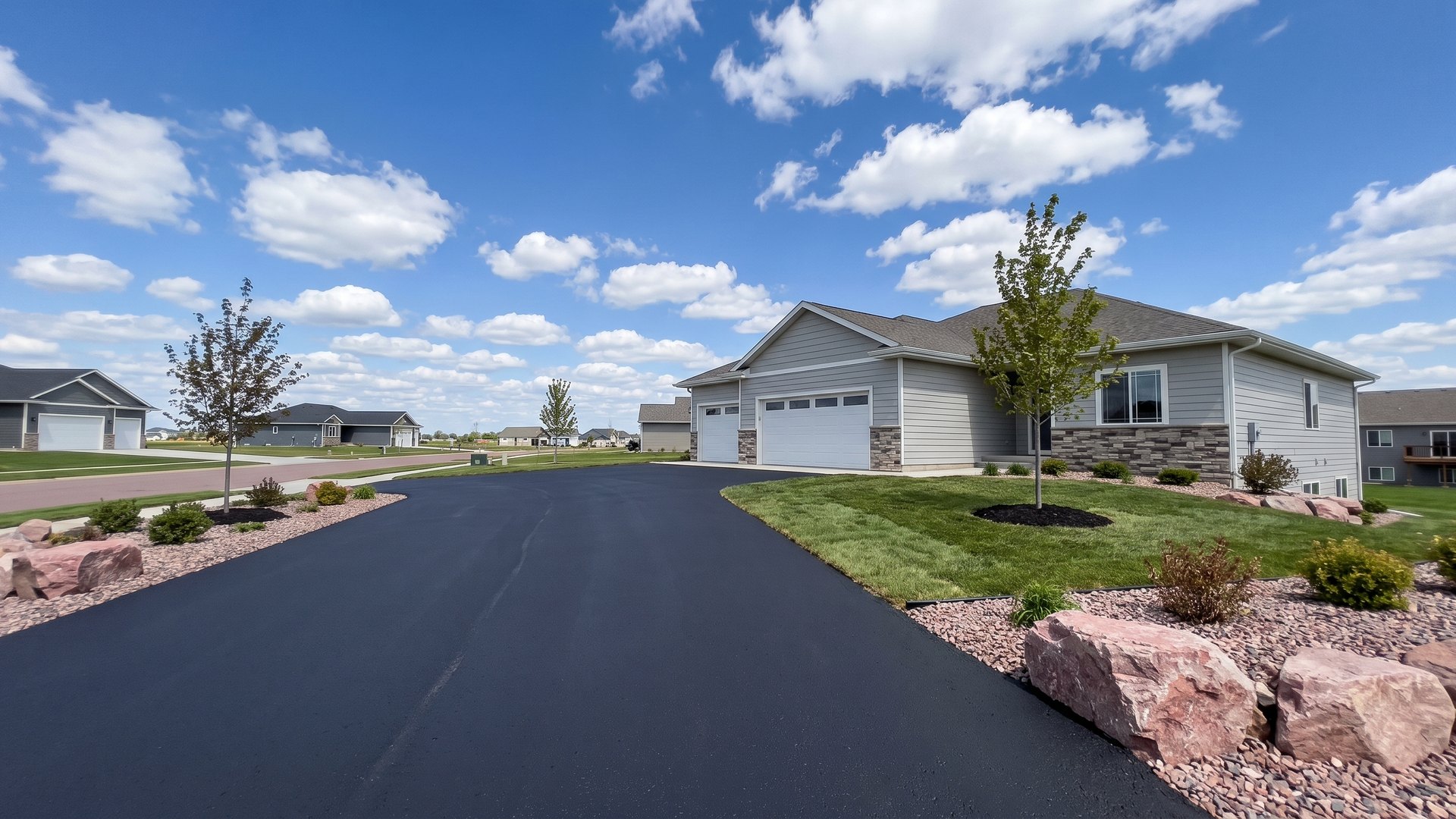
Pink quartzite boulders line a wide, jet-black sealed driveway at a new gray ranch with stone veneer and a three-car garage

Sealcoating Sioux Falls SD

(605) 777-0151

Free Sioux Falls quotes for new and older driveways.

Asphalt Sealcoating for Sioux Falls Driveways and Lots

Pavement at the Sioux Falls airport station crosses the freezing line about 99 days a year, yet normal nights stay above 50 degrees only from June through August. That short window decides when sealing works here, and what it costs.

  • About 99 freeze-thaw days a year at Sioux Falls Foss Field (NOAA 1991-2020)
  • Normal lows top 50F only in June, July and August, the core sealing months
  • Half of the city's homes were built in 1993 or later, per Census ACS data
Young pavement

Why Sioux Falls asphalt needs sealing on a short summer clock

Much of the blacktop in Sioux Falls is young. The city counted 81,182 people in 1980 and 192,517 in 2020, and the Census Bureau's estimate for mid-2025 is 213,748. Housing kept pace: the American Community Survey puts the median home at 1993, and about 41 percent of the city's 90,271 housing units were built in 2000 or later. Public Works already maintains more than 900 miles of centerline streets and adds 10 to 15 miles a year. A large share of local driveways and parking lots are therefore in their first or second decade, the stage where seal coating protects binder that is still there instead of trying to rescue a surface that has already lost it.

Winter here is less a single freeze than a long run of them. NOAA's 1991-2020 normals for Sioux Falls Foss Field show 164 nights a year at or below 32 degrees but only 65 days when the high stays below freezing, so on roughly 99 days the pavement freezes and thaws again. March is the worst month, with close to 20 of those crossings. Each one lets water that has soaked into the surface expand as ice and pry the aggregate apart. Driveway sealing does not stop the cold. It closes the surface so less water is inside the asphalt when the cold arrives.

The catch is the calendar. SealMaster's application guidance says not to seal when the temperature will drop below 50 degrees within 24 hours or when rain is due in that time. At Foss Field the normal low clears 50 only in June, July and August; May averages about 21 nights at or below 50 and September about 16. The dependable sealing season is roughly three months long, and it overlaps the wettest stretch of the year, with June averaging the most days of measurable rain. Crack filling runs on a different clock: hot rubberized filler is meant to go in between 45 and 65 degrees, which points to April, May, late September and October.

This site exists to make those choices easier. It explains the work in plain terms, publishes the price ranges that national cost guides report, and passes quote requests to independent contractors who work in Sioux Falls and in towns such as Brandon, Harrisburg, Tea and Hartford. The cost page shows each range with its source, and the driveway sealing page walks through what a complete job on local pavement includes, from crack prep to the cure.

Free quote

Fields marked * are required.

Fast response during business hours. No obligation.

Work described

What crews do to driveways and lots from Hartford to Brandon

Stacked stone trims a gray ranch whose three-car driveway gleams with new sealer near the doors and fades to gray toward the curb

Driveway Sealcoating

Two coats of sealer over a cleaned, crack-filled residential drive, scheduled for the June-to-August stretch when Sioux Falls nights stay above 50 degrees and the film can cure properly.

Typical: $1 - $2 per sq ft; about $400 - $800 for a 400 sq ft two-car drive

Straight as a ruler, fresh crack filler runs up the center seam of a wide driveway toward a stone-faced ranch

Crack Filling and Sealing

Hot rubberized filler worked into cleaned cracks during the cool spring and fall weeks, when Sioux Falls cracks open widest, so meltwater stops reaching the silty base.

Typical: $1 - $3 per linear ft; about $100 - $400 for a typical driveway

Along the lawn edge of a faded, cracked driveway, a long, narrow patch of new asphalt runs toward ornamental grasses and pink boulders

Asphalt Patching and Repair

Cut-out hot-mix patches for soft spots, potholes and broken edges, placed after the spring thaw once the base has drained, so each patch sits on firm ground before sealing.

Typical: $100 - $500 per patch; $2 - $5 per sq ft for larger areas

Stone pillars and dark canopies front a new retail strip whose parking stalls are sealed black while the broad drive aisle stays faded gray

Parking Lot Sealcoating

Sealcoat for apartment, retail, church and office lots, phased around business hours, timed to the short Sioux Falls warm season, with drive lanes given an extra coat.

Typical: $0.10 - $0.30 per sq ft at commercial scale

Concrete wheel stops head each crisp white stall on new sealcoat, backed by pink boulders, staked young trees and a distant skyline

Parking Lot Line Striping

Stall lines, arrows, fire lanes and accessible spaces painted on Sioux Falls lots after sealcoat cures, laid out to the city's marking rule and the federal ADA space counts.

Typical: $4 - $5 per standard stall; $25 - $40 per accessible stall

Rows of pink-blossomed trees stand beyond new sealcoat and bright stall lines, with a pink boulder and a stone-veneer corner up close

Asphalt Maintenance Plans

A yearly schedule for Sioux Falls lots and long drives: a thaw-season inspection, crack sealing in the shoulder months, sealcoat about every three years, restriping and winter prep.

Typical: Per task: $0.10 - $0.30 per sq ft to seal; $0.35 - $1.00 per linear ft to crack seal

Parked on the lawn by two pink boulders, a yellow roller sits near a still-steaming driveway of new asphalt at a stone-veneer ranch

Asphalt Paving

New and replacement asphalt driveways on Sioux Falls lots: a stone base built for frost-prone silty ground, 2 to 3 inches of hot mix, and the approach permit sorted out.

Typical: $5 - $15 per sq ft installed; about $2 per sq ft more to remove an old drive

How this site helps a Sioux Falls owner compare bids

Numbers from Foss Field, not a national average

The weather figures on this site come from NOAA's 1991-2020 normals for Sioux Falls Foss Field, the airport station on the north side of town: about 99 freeze-thaw days, 44.5 inches of snow, a median last spring freeze on May 3 and a median first fall freeze on September 29. Advice about when to seal or fill cracks is built from those dates, so it fits a 146-day freeze-free season rather than a milder one farther south.

Price ranges with the source named

No Sioux Falls contractor price list could be verified for this site, so the cost page uses published ranges from HomeGuide, Angi, Fixr and SealMaster and says which source backs each line. That gives an owner a yardstick for reading bids. A two-car driveway priced far outside the range deserves a question about square footage, the number of coats or whether crack filling is included.

Independent contractors, one request

Quote requests sent from this site go to independent contractors who work in Sioux Falls, across Minnehaha and Lincoln counties and in towns such as Brandon, Harrisburg, Tea and Hartford. The site does not do the work and does not rank crews. It describes what a sound job on local ground looks like, so an owner can judge the bids that come back on the same terms.

Timing advice for a three-month season

With normal lows above 50 degrees only from June through August, the order of work matters a great deal: cracks filled in the cool shoulder weeks, sealer in summer, then a dry cure with sprinklers off. The pages on this site lay out that order, including the city's odd-even lawn watering schedule and the snow-gate rule that decides where winter snow piles up beside a driveway.

Job order

The order of a sealing job in a June-to-August season

  1. Walk the pavement after the spring thaw

    Late April or early May, once frost has left the ground, is the time to measure the drive or lot and look at it closely. Heaved or sunken spots show up after the thaw, the same period when South Dakota lets road authorities impose spring load limits, from February 15 to April 30. Note cracks wider than a coin edge, soft spots, oil stains and any sump line or downspout that drains across the asphalt.

  2. Fill cracks in the cool shoulder weeks

    SealMaster's cold-climate advice is to apply hot rubberized crack filler when the air is between 45 and 65 degrees, because cracks are open wide then. Here that means spring or fall. Each crack is cleaned with a wire brush, router or hot air, filled, and finished with a thin band on either side, kept low so a snowblower or plow blade does not catch it. The crack filling page covers widths and materials.

  3. Seal on a warm, dry day from June to August

    The surface is blown clean, oil spots are primed, and two coats go on, the first often by squeegee to work sealer into the pores and the second by spray for an even film. SealMaster's guidance is to skip any day when the temperature will fall below 50 degrees or rain is expected within 24 hours, and to add a third coat where traffic concentrates, such as entrances and drive lanes.

  4. Protect the cure, then plan the next round

    Foot and vehicle traffic stay off for at least 24 hours. Irrigation zones that reach the pavement should be shut off for the cure, which the city's watering schedule makes easier: odd and even addresses water on alternate dates, and lawn watering is banned from noon to 5 p.m. After that, SealMaster's typical resealing interval is about three years, shorter where traffic or winter wear is heavy.

Ground and rules

Loess, quartzite, snow gates and the Big Sioux River

Under the lawns, the eastern two-thirds of Minnehaha County is glacial till capped in most places by loess, according to the county's Envision 2045 comprehensive plan. NRCS describes the Egan series, which it lists as of large extent in east-central and southeastern South Dakota, as 25 to 40 inches of silty sediment over loam or clay loam till, with moderate permeability in the silt and slow permeability in the till below. That pairing matters for pavement. Silty soils are among the most frost-susceptible because they feed water to growing ice lenses, and a slow layer underneath keeps that water close. A driveway on this ground moves more through a winter than one built on the sand and gravel the county plan places along river and stream beds.

Beneath the till is Sioux quartzite, the red to pink Proterozoic stone that the Queen Bee Mill was built from in 1881, quarried on site at what is now Falls Park. The county plan calls it the bedrock for the entire county, found near the surface in scattered spots across the eastern half. It has been quarried since settlement, the plan counts four working stone quarries in the unincorporated county, and local gravel and stone go to uses as ordinary as sub-grade material for roads. The Big Sioux River loops around the center of the city; an Army Corps project finished in 1961 added a 15,000-foot diversion channel and 29 miles of levees. City storm drains carry runoff to that river, so whatever washes off a sealed driveway ends up in it.

Snow and summer storms add their own load. Foss Field averages 44.5 inches of snow a year, with December, January and March each bringing close to 8 inches, and 26 nights a year fall to zero or below. The state highway department notes that salt only works down to about 15 degrees, which is why sand takes over on state highways in the coldest spells. Summer brings wind and hail: two derechos crossed the area in 2022, and the airport gusted to 80 mph in the July storm. City permit records say a typical year includes at least one hail event worth 1,800 to 2,000 roof permits, and 2022 topped 5,000. Each re-roof can put a roll-off dumpster on a driveway, where its steel rails press the load into a few square inches.

The city's own street work is a useful model. Public Works maintains more than 900 centerline miles, mostly asphalt with about 14 percent concrete, and treats streets that are still in good condition with a half-inch slurry seal of asphalt oil and small rock to stretch the time before major rehabilitation. Worn streets get about 2 inches milled off and a new asphalt overlay. The overlay program's notices remind residents that maintaining the driveway approach and the gutter in front of it is the property owner's job, and the Engineering division publishes a pavement condition map. Treating a surface while it is still sound, not after it fails, is the same reasoning behind sealing a private drive.

A few rules touch nearly every job. Section 160.553 of the zoning code requires residential parking spaces and the drives to them to be hard-surfaced with asphalt, concrete or equivalent, and section 160.556 requires commercial parking and drive areas to be hard-surfaced and striped. Work in the right-of-way, such as a new or replaced approach, runs through a Right of Way Sidewalk/Driveway Approach permit filed online or at City Center. During a snow alert, motorgraders work in pairs and the second one drops a snow gate so the windrow lands beside the driveway, and residents may not push driveway snow back into the street. No South Dakota city, county or state appears on the national coal-tar sealant ban lists, although Minnesota, across the county's eastern line, has banned it statewide since 2014.

The housing record splits the city into two maintenance problems. The Census Bureau's 2020-2024 survey counts 3,545 homes built in 2020 or later and 17,423 from the 2010s, many of them along the new streets the city adds every year, where driveways are waiting for or just past their first coat. At the other end are 7,832 homes built before 1940, in the older core that holds historic districts such as Cathedral, listed in 1974, and All Saints and McKennan Park, both listed in 1984. An old drive, or one laid over an older one, raises different questions: whether the base is still sound and whether patching or an overlay beats sealer. The first-seal guide covers the new end of that range.
Price ranges

What sealing and asphalt repair cost around Sioux Falls

The figures below are observed market ranges, not quotes. They come from national cost guides published by HomeGuide, Angi and Fixr, and from SealMaster, a sealcoat manufacturer that publishes contractor pricing, because no Sioux Falls contractor price list could be verified for this site. Local bids can land above or below them. What the ranges do well is expose a bid that is missing something: a two-car driveway quoted at a fraction of the range may be a single thin coat with no crack work, and one far above it may include patching the owner never asked about.

Service Typical Sioux Falls Range
Two-car driveway, about 400 sq ft, cleaned and sealed $400 - $800
Three-car driveway, about 864 sq ft, cleaned and sealed $860 - $1,700
Residential sealing, labor and material $1.00 - $2.00 per sq ft
Hot rubberized crack filling $1 - $3 per linear ft
Owner questions

What Sioux Falls property owners ask about their asphalt

What does driveway sealing cost in Sioux Falls?

Published national ranges are the most useful yardstick available, because no local price list could be verified. HomeGuide puts professional sealing at $1 to $2 per square foot, which works out to $400 to $800 for a 400-square-foot two-car driveway and $860 to $1,700 for a three-car drive of about 864 square feet. Fixr's average for a 20-by-20-foot drive is $468. Crack filling adds $1 to $3 per linear foot. The full price table lists every range with its source.

When is sealing season in Sioux Falls?

The dependable window is June through August. Sealer needs a day that stays above 50 degrees for the following 24 hours with no rain expected, and at Foss Field the normal overnight low is above 50 only in those three months. May and September still have warm stretches, but May averages about 21 nights at or below 50 and September about 16, so a crew has to choose days carefully. October, with a normal low of 36 degrees, is too cold for sealer.

Is coal-tar sealer allowed here?

Yes. No South Dakota city, county or state rule restricting coal-tar sealant appears on the national ban lists kept by Coal Tar Free America and Asphalt Kingdom, while Minnesota banned its sale and use statewide on January 1, 2014. The USGS reports that coal-tar products carry roughly 1,000 times the PAH concentrations of asphalt-based sealers, and Sioux Falls storm drains discharge to the Big Sioux River, so it is reasonable to ask which product a bid includes.

How long should a new asphalt driveway wait before its first seal?

At least three months, often longer. Angi advises waiting three months so fresh asphalt can finish hardening, HomeGuide gives three to six months, and Asphalt Kingdom notes that a drive paved in cold months may need more than six. Because the reliable sealing months here are June through August, a drive paved after midsummer usually waits for the next June. The new asphalt guide works through the calendar month by month.

Who is responsible for the driveway approach and the gutter?

The property owner. The city's overlay program notices state that maintenance and repair of the driveway approach and the associated gutter are the owner's responsibility. Replacing an approach or a sidewalk section in the right-of-way calls for a Right of Way Sidewalk/Driveway Approach permit, filed through the city's Customer Self Service portal or in person at City Center. When a crew proposes to cut or replace the approach, ask whether that permit is part of its price.

Why does the driveway seem to crack most in March?

March is when the freeze-thaw cycle peaks. Foss Field averages about 26 nights at or below freezing in March but only 6 days that stay below freezing all day, so on nearly 20 days the surface freezes at night and thaws by afternoon. Melting snow supplies the water. Each cycle widens cracks a little, and the silty soils common in the county heave when that water feeds ice lenses beneath the pavement.

Do the city's snow gates keep snow out of the driveway?

They reduce it. During a snow alert the motorgraders run in pairs, and only the second grader, the one nearest the curb, uses its gate, so most of the windrow lands at the side of the driveway instead of across it. The city notes that gates may be set aside when snow is too deep or wet for them to work. The piles left at the edges melt and refreeze on each warm afternoon, which keeps the edge of the drive wet through the thaw.

Should sprinklers or sump lines be changed before sealing?

For the cure, yes. Sealer needs at least 24 hours without water, and the city's lawn schedule lets odd and even addresses water on alternating dates outside the noon to 5 p.m. ban, so an automatic system can come on the morning after a crew leaves. Shut off zones that reach the drive. Sump lines may discharge to the street gutter or the lawn but never to the sanitary sewer; one that empties across the asphalt keeps it wet all year and is worth moving to the lawn.

Is seal coating worth it on a driveway that is only a few years old?

Usually that is when it helps most. SealMaster describes sealcoat as blocking water, oils and UV light and replenishing binder lost to weathering, and says a program of crack filling and sealcoating can more than double pavement life. A drive in one of the city's newer subdivisions still has most of its binder, and the point is to keep it. The exception is the first few months after paving, when fresh asphalt should be left to cure.

Does this site do the sealing?

No. Sealcoating Sioux Falls SD is an information and referral site. It explains the work, publishes sourced price ranges and sends quote requests to independent local contractors who serve Sioux Falls, Brandon, Harrisburg, Tea, Hartford and nearby towns. Each contractor sets its own price, schedule and terms, and the about page explains where the figures on the site come from.

Coverage

Neighborhoods plus Minnehaha and Lincoln County towns covered

Cathedral Historic District All Saints McKennan Park Terrace Park Sunnymede Stoney Creek Brandon Harrisburg Tea Hartford Crooks Renner Baltic Lennox Canton Dell Rapids Garretson Valley Springs

Send a Sioux Falls sealing request to local contractors

Give the area, the rough size and what the asphalt looks like. The request goes to independent contractors who work in Sioux Falls and nearby towns.

Free quote

Fields marked * are required.

Fast response during business hours. No obligation.